
Electric Vehicle Chargers in Australia

It’s safe to say that buying electric cars is more than just a fad. Since their introduction to the Australian market, electric vehicles (EVs) have been increasingly popular. With the exponential growth of EVs comes the infrastructure to support them. Charging stations have been and are continuing to be built all over Australia.
EV charging locations in Australia: What's happening now?
According to the latest report from the Electric Vehicle Commission, 72,758 electric vehicles were sold in Australia in 2025. Electric vehicles accounted for 24.4% of all new car sales in Australia in 2025, which is a 25.4% increase in market share compared to the same time last year.
It's no wonder that EV charging infrastructures are working to keep pace. More and more charging stations are being built nationwide to match the rapidly growing demand. As of writing, there are over 3,000 public charging points in the country.
Plans for new EV fast charger stations are estimated for 2026
The rollout of fast charging and ultra-fast charging stations in Australia is gaining speed, mostly in cities. But soon, motorists could see more charging stations in regional areas thanks to the efforts of federal, state, and local governments, as well as private investments and partnerships.
As part of the Transport and Infrastructure Net Zero Roadmap and Action Plan, the Federal Government committed $40 million for the deployment of EV charging infrastructure. The goal is to deliver up to 10,000 public chargers across Australia. The plan includes the rollout of both EV kerbside and fast charging. All of this is in line with Australia’s commitment to meeting the legislated emissions reduction targets.
The Federal Government’s investment will also go into establishing strategic partnerships between distribution network service providers and EV chargepoint operators. Driving the Nation Fund (also called DRIVEN) has allocated $39.3 million to the NRMA to install public fast charging stations across key highway routes. The goal is to meet the growing demand for public charging options to further develop public charging infrastructure.
Fast and ultra-fast charging stations, state-by-state
Each charging location contains multiple charging stations, bays, or points. One charging location is capable of charging several electric vehicles at once. The table below does not include all available charging stations.
| State | Fast | Ultra-Fast | Total |
|---|---|---|---|
| Australian Capital Territory | 20 | 10 | 30 |
| New South Wales | 214 | 143 | 357 |
| Northern Territory | 11 | 5 | 16 |
| Queensland | 139 | 96 | 235 |
| South Australia | 47 | 89 | 136 |
| Tasmania | 44 | 9 | 53 |
| Victoria | 211 | 100 | 311 |
| Western Australia | 62 | 70 | 132 |
| Australia | 748 | 522 | 1,270 |
Source: State of Electric Vehicles 2025, Electric Vehicle Commission
New South Wales has the most fast and ultra-fast charger stations with 357, while the Northern Territory has the least with 16, but it’s still an improvement from 12 the previous year. Some states and territories may have more than others. The urban areas may have significantly more EV charging locations than rural areas.
Understanding EV charging stations
Here's a quick overview of the different charging stations and where you can find them.
Types of charging stations
Electric vehicle charging stations in Australia have three levels or modes. Each has a corresponding voltage and charging speed. Here's an overview of the main types of charging stations:
- Level 1/Model 2: This is also known as a slow charging station and could add 10km to 20km of range per hour. It's usually used with a specialised cable supplied with the electric car. This type of charging station can be seen in standalone homes. It's ideal for topping up your EV, but won't fully recharge it overnight.
- Level 2/Mode 3: This is classified as fast charging with a dedicated AC EV charger. Charging with a level 2 station could add 40km to 100km of range per hour. It can deliver a full recharge when left overnight. These charging stations can be found in residences, apartment complexes, hotels, and workplaces.
- Level 3/Mode 4: These charging stations are considered rapid charging. They are dedicated DC EV chargers with power levels ranging from 25kW to 350kW. These are mostly found in roadside charging stations or commercial premises. Ultra-fast charging stations can fully recharge some electric cars in 15 minutes or less.
Charging times also depend on the kind of electric vehicle you own. Smaller electric vehicles like sedans and hatchbacks charge more quickly than bigger ones like SUVs and vans, regardless of the charging station.
Different EV charger levels
Not all EV chargers are made the same. The charging speeds of EV chargers and charging stations may differ based on various factors. There are three EV charger levels: slow, medium, and fast.
Level 1: Slow charging
This type of EV charger delivers a charge of about 2kW per hour. These types of chargers usually plug into a 10A power point and come standard with most EVs. This slow charger is best for charging small batteries or for electric cars that aren’t used frequently.
Level 2: Medium charging
A medium charging unit can provide 7.2kW of power from a 240V AC single-phase connection. It provides a much faster charge than level 1. Charging units for medium charging are installed on the wall by licenced electricians. If you want an at-home charging unit, a level 2 is an ideal choice so you can charge your EV overnight.
Level 3: Fast charging
Level 3 EV charging is high-voltage direct current or DC chargers. You can find this type of charging unit in public charging stations. A level 3 charging unit can deliver 50kW or up to 350kW of power, depending on the specific type of charger.;
Level 4: Super-fast or rapid charging
This type of EV charger produces 120kW of power and has a range added per hour of 400km to 500km. Charging time for a level 4 charger ranges from 20 to 40 minutes. EV chargers like this are found near highways, motorways, or other key routes.
Level 5: Ultra-fast charging
This is the fastest type of EV charger there is. It can deliver an estimated 350kW and can charge an EV in 10 to 15 minutes. Because it requires so much power, you’ll find this in public charging stations like highways and motorways.
Types of EV chargers
Usually, car manufacturers in Australia provide EV buyers with a minimum charging option with a standard 10-Amp plug. This is what you’d typically find at home, making it easy for owners to charge their EVs. Other standard plugs used in Australia are the following:
- Type 2 or Mennekes plug – Used for AC charging.
- CHadeMO – Used for DC charging.
- CCS – Used for AC and DC charging.
Charging station networks in Australia
Motorists have a lot of options when it comes to where they can charge their electric vehicles. Here are the major charging networks in Australia and where they're located:
- Tesla Supercharger Station - Tesla has over 60 charging locations across New South Wales, Victoria, and the Australian Capital Territory.
- BP Pulse - BP Charging Stations has around 15 locations in Queensland, New South Wales, and Victoria.
- AMP Charge - With over five locations, Ampol Charging Stations can be found in Queensland, New South Wales, Victoria and Western Australia.
- Evie Networks - The second-largest EV charging network in the country, with over 200 stations. Found in New South Wales, the Australian Capital Territory, Victoria, Queensland, and Western Australia.
- Charge Fox Charging Station - You can find the 450 Charge Fox stations across Queensland, New South Wales, and Victoria.
- NRMA Charging Station - These charging stations can be found on major roads in New South Wales and the Australian Capital Territory.
- Jolt - This charging network has around 35 stations in Sydney, Melbourne and Adelaide.
- Charging point - There are Charging point stations in Victoria, New South Wales and Queensland.
The charging stations range from regular to ultra-fast charging. More populated cities typically have more fast and ultra-fast charging stations on major roads. You can find the nearest online using websites like Plugshare.
The cost of EV charging in Australia
Charging fees vary depending on the supplier, location, electric vehicle, and duration. Usually, EV charging can cost around $0.50/kWh at DC charging stations.
AC Charging Stations
AC charging stations have a power of 2.3kW to 22kW. There are free AC charging stations, but paid ones cost around $0.40 to $0.70 per kWh. These charging stations are usually found in car parks or shopping centres and are great for a quick top-up.
DC Charging Stations
DC fast chargers are becoming more common in Australia. These have a power of around 50kW to 300kW and cost roughly $0.60 to $1.00 per kWh. Although a bit more expensive than the AC charging station, they offer faster charging times. Most charging networks like Tesla, Chargefox, Evie Networks, and NRMA networks offer DC fast charging stations.
Home charging cost
Charging at home is considered the cheaper option than going to charging stations. It all depends on the average electricity costs in your area.
Even if home charging costs less per kWh, you need to include upfront installation costs when considering affordability. Wall chargers typically cost between $550 to $2,125, depending on the brand.
If you're installing a level 1 charging station at home, you can use the standard outlet within the house. However, if you don't have any outlets in your garage, you'll need to get one installed, which could cost around $200 to $1,000.
A level 2 charging station, on the other hand, could cost somewhere from $600 to $2,500 plus an installation fee of $500 to $1,500. This type of charging station is more powerful and can recharge your electric vehicle much more quickly.
How to charge an electric car at home
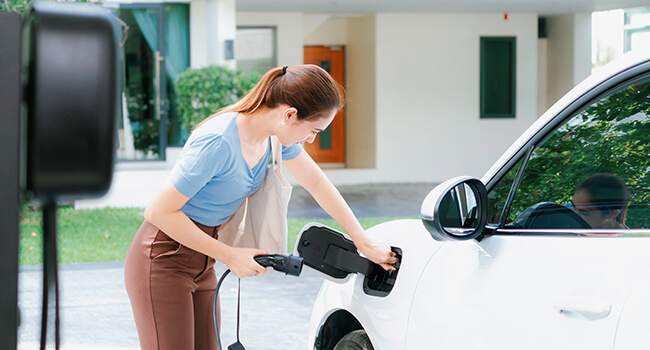
Charging electric cars at home varies based on the type of charging unit you have. If you have a level 1 charger, simply use the charging cable that comes with your EV and plug it into a regular power outlet.
If you have a level 2 charger installed in your home, you can get a much faster charge. This is great for those who use their EVs frequently and for long distances. This option may be more costly as it requires more equipment and professional installation. However, it may also be more convenient depending on your needs.
Level 3 chargers or higher aren’t as practical for at-home use as they require way more power than you’ll probably need. These chargers are best for public charging stations found in motorways or street-side charging.
Are you interested in buying an electric car?
See what type of EV is right for your price range by getting pre-approved for a car loan with competitive rates and useful features. Learn more about your car finance options when you get in touch with us or apply online today!
Find out in under 2 minutes if you qualify for one of our car loans.

About the article
As Australia's leading online lender, loans.com.au has been helping people into their dream homes and cars for more than 10 years. Our content is written and reviewed by experienced financial experts. The information we provide is general in nature and does not take into account your personal objectives or needs. If you'd like to chat to one of our lending specialists about a home or car loan, contact us on Live Chat or by calling 13 10 90.